Complete solved question paper
SECTION – A : Multiple Choice Questions
Q1. Study the information given bellow carefully and name the place related to it.
० Water harvesting for agriculture.
० This reservoir was located in Gujarat.
Identify the town related to the above from the following options –
(A) Ropar (B) Dholavira (C) Kalibangan (D) Shortughai
✅ Answer: (B) Dholavira
Explanation: Dholavira (in Kutch, Gujarat) is famous for its unique system of water reservoirs and rainwater harvesting used for agriculture.
Q2. The most unique aspect of the Harappan cities was the development of —
(A) Agriculture (B) Planned cities (C) Animal husbandry (D) Trade
✅ Answer: (B) Planned cities
Explanation: The Harappans built systematically planned towns with grid layouts, brick houses, drainage, and water management — a hallmark of urban planning.
Q3. Which of the following was the best source of Lapis Lazuli in the Harappa sites?
(A) Nageshwar (B) Shortughai (C) Manda (D) Khetri
✅ Answer: (B) Shortughai
Explanation: Shortughai in northeast Afghanistan was the main source of lapis lazuli, a precious blue stone traded to Harappan sites.
Q4. Which of the following is not a factor that made Magadha the most powerful mahajanapada in 600 BCE?
(A) Fine quality of beads in Magadha forests
(B) Accessibility to iron-ore mines
(C) Rivers for communication
(D) Ambitious kings
✅ Answer: (A) Fine quality of beads found in the forests of Magadha
Explanation: Magadha’s power came from iron resources, river routes, and dynamic rulers — not from bead production.
Q5. During which century was the capital of Magadha shifted to Pataliputra?
(A) 5th Century BCE (B) 4th Century BCE (C) 2nd Century BCE (D) 3rd Century BCE
✅ Answer: (A) 5th Century BCE
Explanation: The capital was shifted from Rajagriha to Pataliputra around the 5th century BCE under Ajatashatru’s reign.
Q6. In which language has the Allahabad Pillar Inscription been composed?
(A) Prakrit (B) Hindi (C) Sanskrit (D) Brahmi
✅ Answer: (C) Sanskrit
Explanation: The Prayag Prashasti (Allahabad inscription) of Samudragupta was written in Sanskrit language using Brahmi script.
Q7. In which type of marriage does a man keep several wives?
(A) Endogamy (B) Exogamy (C) Polygyny (D) Polyandry
✅ Answer: (C) Polygyny
Explanation: Polygyny means one man having more than one wife; polyandry means one woman with several husbands.
Q8. Identify the social category:
(i) Handled corpses and dead animals.
(ii) Lived outside villages, used discarded utensils, wore clothes of the dead.
(A) Nishadas (B) Chandalas (C) Kshatriyas (D) Malechchas
✅ Answer: (B) Chandalas
Explanation: Chandalas were considered outcastes in early Indian society, assigned to tasks linked with death and impurity.
Q9. Which of the following pairs is correctly matched regarding the life of Buddha?
(A) Birth – Bodh Gaya
(B) Enlightenment – Sarnath
(C) Preaching – Lumbini
(D) Nirvana – Kushinagar
✅ Answer: (D) Attainment of Nirvana – Kushinagar
Explanation: Buddha was born at Lumbini, attained enlightenment at Bodh Gaya, gave his first sermon at Sarnath, and attained nirvana at Kushinagar.
Q10. Which of the following is part of Tripitaka?
(A) Dipavamsa (B) Dhamma Sutta (C) Mahavamsa (D) Abhidhamma Pitaka
✅ Answer: (D) Abhidhamma Pitaka
Explanation: The Buddhist Tripitaka comprises three texts — Vinaya Pitaka, Sutta Pitaka, and Abhidhamma Pitaka.
Q11. Identify the picture and choose the correct answer:
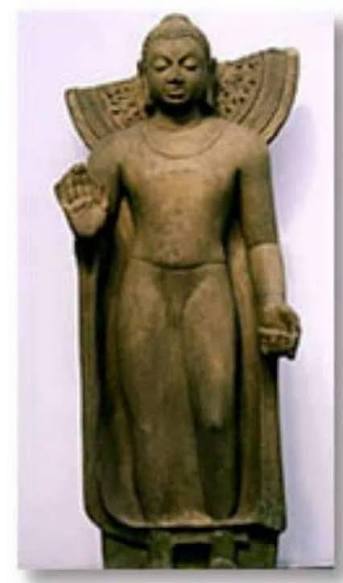
(A) Amaravati style (B) Statue of Buddha, Mathura 1 AD (C) Gandhara style (D) Gothic art style
✅ Answer: (B) Statue of Buddha, Mathura in 1 AD
Explanation: Mathura art shows Indian features — fleshy body, simple robe, serene expression — typical of early Buddha images in North India.
Note: The following question is only for Visually Impaired Candidates in lieu of question no. 11.
Which art style was used in statues of Buddha found in North India.
(A) Amravati style of art
(B) Mathura art style
(C) Gandhara style of art
(D) Gothic style
Answer: B Mathura Art Style.
Q12. Which traveller was appointed Qazi of Delhi by Sultan Muhammad bin Tughluq?
(A) Abdur Razzaq (B) Al-Biruni (C) Ibn Battuta (D) Barbosa
✅ Answer: (C) Ibn Battuta
Explanation: Ibn Battuta, the Moroccan traveller, served as Qazi (judge) under Muhammad bin Tughluq in Delhi.
Q13. Rihla is written by which traveller?
(A) Ibn Battuta (B) Marco Polo (C) Francois Bernier (D) Barbosa
✅ Answer: (A) Ibn Battuta
Explanation: Rihla (“The Journey”) is Ibn Battuta’s account of his extensive travels.
Q14. Identify the traveller: He was a doctor, political philosopher, historian; in India 1656–1668 CE; associated with Dara Shikoh.
(A) Al-Biruni (B) Ibn Battuta (C) Francois Bernier (D) Abul Fazl
✅ Answer: (C) Francois Bernier
Explanation: Bernier, a French physician and philosopher, lived at the Mughal court and observed Indian society under Aurangzeb.
Q15. Which statements about Lingayats are correct?
(i) Challenged caste (ii) Questioned rebirth (iii) Followed Dharmashastras (iv) Worshipped Shiva as Linga
(A) (i)(ii)and(iii) (B) (ii)and(iii) (C) (i)(ii)and(iv) (D) All the above
✅ Answer: (C) (i), (ii) and (iv)
Explanation: Lingayats rejected caste and rebirth theory, worshipped Shiva as Linga, but did not accept orthodox Dharmashastra rituals.
Q16. Nalayira Divyaprabandham is described as —
(A) Tamil Veda (B) Bengali Veda (C) Kannada Veda (D) Dharmashastras
✅ Answer: (A) Tamil Veda
Explanation: It is a collection of 4,000 Tamil hymns of the Alvars, revered as the “Tamil Veda”.
Q17. The walls of Hazara Rama Temple have scenes sculpted from —
(A) Mahabharata (B) Ramayana (C) Jataka stories (D) Panchatantra
✅ Answer: (B) Ramayana
Explanation: The temple in Hampi depicts detailed episodes from the Ramayana on its walls.
Q18. Gajapati rulers ruled over which state?
(A) Orissa (B) Deccan States (C) Assam (D) West Bengal
✅ Answer: (A) Orissa
Explanation: The Gajapatis were medieval rulers of Odisha (formerly Orissa).
Q19. Assertion (A): Vijayanagar Empire was known for its advanced water management system.
Reason (R): Rulers built embankments and reservoirs to store rainwater.
(A) Both A and R true, R explains A (B) Both true, R not explain A
(C) A true R false (D) A false R true
✅ Answer: (A) Both (A) and (R) are correct, and (R) explains (A)
Explanation: The Vijayanagara rulers built tanks and embankments along hill streams, showing advanced water engineering.
Q20. Match the following regarding Mughal land-revenue system:
| List-I | List-II |
|---|---|
| A Jama | 4 Amount assessed |
| B Khet batai | 3 Division after sowing |
| C Lang batai | 2 Division after cutting grain |
| D Hasil | 1 Amount actually collected |
Code :
(A) A-4, B-3, C-2, D-1 (B) A-1, B-2, C-3, D-4
(C) A-3, B-4, C-1, D-2 (D) A-4, B-2, C-1, D-4
✅ Answer: (A) A-4, B-3, C-2, D-1
Explanation: Jama = assessed revenue; Khet batai = field division after sowing; Lang batai = share after harvest; Hasil = actual collection.
Q21. During the Mughal period, which tribe traded between India and Afghanistan and visited Punjab towns?
(A) Sarraff (B) Koch (C) Ahom (D) Lobanis
✅ Answer: (D) Lobanis
Explanation: The Lobanas (or Lobanis) were nomadic traders and transporters active on routes between India and Afghanistan, often found in Punjab.
Section B (Short Answer type questions)
Perfect 👍 Below are Section-B (Short-Answer Type, 3 marks each) answers written in English, exactly in CBSE board pattern — concise, point-wise, and deeply researched (3 key points each).
Q22 (A). Explain any three strategies for procuring materials by the Harappans for craft production.
- Local procurement: The Harappans used locally available raw materials such as clay, stones, timber, and copper from nearby regions for craft and construction.
- Long-distance trade: Precious materials like lapis lazuli (from Shortughai), carnelian (from Gujarat), and copper (from Rajasthan) were obtained through trade networks.
- Centralized workshops and standardization: Specialized craft centres collected and distributed materials, maintaining uniformity through standard weights and measures.
OR
Q22 (B). Mention any three distinctive features of the burials in the Harappan culture.
- Varied burial practices: Different methods such as extended burials, pot burials (urns), and brick-lined graves were followed.
- Grave goods: Pottery, ornaments, and small tools were often placed with the dead, showing belief in an afterlife and social differentiation.
- Designated burial grounds: Cemeteries were located outside the settlements, reflecting organized town planning and ritual space separation.
Q23. Describe the sources used to construct the history of the Mauryan Empire.
- Epigraphic sources: Ashokan rock and pillar edicts provide first-hand information about administration, policies, and moral principles (Dhamma).
- Literary sources: Indica by Megasthenes, Buddhist texts (like Ashokavadana), and Puranic records reveal political, social, and economic aspects.
- Archaeological and numismatic evidence: Excavated remains, coins, and inscriptions help understand urban centres, economy, and imperial control.
Q24. Briefly describe any three features of the temples built at the time when the Stupa was at Sanchi.
- Stone construction and ornamentation: Temples and gateways (toranas) were elaborately carved with scenes from Buddha’s life and Jataka tales.
- Chaitya halls and assembly structures: Early Buddhist architecture included prayer halls built around stupas, emphasizing community worship.
- Narrative sculpture: Religious stories and symbolic motifs were used for spiritual teaching as well as aesthetic appeal.
Q25. State the inherent problems faced by Al-Biruni in the task of understanding Indian and Brahmanical practices.
- Language barrier: Al-Biruni did not initially know Sanskrit and relied on interpreters, leading to translation and comprehension difficulties.
- Limited access to knowledge: Many Brahmanical texts and rituals were considered sacred and restricted to Brahmins, reducing his exposure.
- Cultural differences: His Islamic philosophical framework often clashed with Indian concepts like karma and rebirth, creating interpretational gaps.
Q26. What was the attitude of Alvars and Nayanars towards caste system?
- Rejection of caste hierarchy: Both Alvars (Vishnu devotees) and Nayanars (Shiva devotees) opposed caste-based discrimination and ritual superiority.
- Equality through bhakti: They emphasized devotion (bhakti) as the true means of salvation, accessible to all regardless of birth or status.
- Use of local language and temple worship: By composing devotional hymns in Tamil, they made religion inclusive and participatory for common people.
Q27 (A). “The geographical location of this place played an important role in the development of Vijayanagara as an empire.” Explain.
- Natural defense: The rocky hills and Tungabhadra River provided strong natural fortification and security against invasions.
- Water management and agriculture: Streams from the hills were dammed to create reservoirs, supporting irrigation and food supply.
- Trade and communication: Its central location facilitated inland trade and contact with southern ports, boosting economic prosperity.
OR
Q27 (B). What do you think was the significance of the rituals associated with Dibba?
- Political legitimacy: Rituals performed on the Mahanavami Dibba symbolized royal authority and divine sanction of the king’s rule.
- Social cohesion: These ceremonies brought together different groups—royals, nobles, and commoners—strengthening unity and loyalty.
- Economic and cultural exchange: Gifts and tributes presented during the rituals reflected redistribution of wealth and the empire’s grandeur.
Section ‘c’ Long Answer type questions
Question 28 (A) Who were the forest dwellers? How did their lives change in the 16th and 17th centuries?
Answer:
- Definition: Forest dwellers were tribal and nomadic people who lived in forests and hilly regions, depending mainly on hunting, gathering, and shifting cultivation.
- Lifestyle: They practiced jhum (slash and burn) cultivation instead of settled agriculture.
- Social setup: Their society was egalitarian, with no rigid caste or class distinctions.
- Trade contact: During the 16th–17th centuries, their contact with traders, peasants, and state authorities increased.
- Revenue demands: The Mughal state started collecting taxes from forest products such as honey, wax, and wood.
- Agricultural expansion: The spread of settled agriculture led to forest clearance, forcing them to take up farming or labour.
- Military role: Many tribal groups like the Gonds and Bhils were recruited into the Mughal army.
- Result: Over time, they became part of the mainstream rural economy, losing their earlier independence and forest-based lifestyle.
Question 28 (B) OR
Describe the caste system and rural environment of Mughal India. How were caste panchayats important in village society during the Mughal period?
Answer:
- Rural setup: The village was the basic unit of social and economic life in Mughal India, mainly agricultural.
- Caste hierarchy: Society was divided into castes — Brahmins, Kshatriyas, Vaishyas, Shudras, and untouchables.
- Occupational division: Each caste or sub-caste had specific occupations such as carpenters, weavers, and blacksmiths.
- Social order: The caste system regulated behaviour, marriage, and occupation.
- Caste panchayats: Each caste had its own local council or panchayat to regulate internal affairs.
- Functions: These panchayats settled disputes related to marriage, property, and social conduct.
- Power: They could impose fines, social boycotts, or other punishments to enforce discipline.
- Significance: Thus, caste panchayats maintained social harmony and controlled the functioning of rural life during the Mughal era.
Question 29 (A)
Identify the relationship between Sufi Saints and the State from the 8th to the 18th centuries.
Answer:
- Sufi movement: The Sufis were mystics who emphasized love, devotion, and closeness to God.
- Initial independence: In early times, they stayed away from political power and court influence.
- Spiritual authority: Their popularity among people gave them great moral and social influence.
- Royal contact: Gradually, rulers sought their blessings and support to legitimize their rule.
- Patronage: Sufi shrines and khanqahs received land grants (waqf) and donations from kings.
- Mutual benefit: Kings gained spiritual approval, and Sufis received resources for charity and teaching.
- Public service: Many Sufis mediated between the ruler and the public, helping in social welfare.
- Conclusion: Over time, the bond between Sufi saints and the state reflected both spiritual cooperation and political utility.
Question 29 (B) OR
Explain the main beliefs and teachings of the Chishtis during the medieval period.
Answer:
- Origin: The Chishti order was one of the most influential Sufi traditions in India.
- Founder: It was introduced by Khwaja Muinuddin Chishti of Ajmer in the 12th century.
- Core belief: They taught that love, compassion, and humility are the true paths to God.
- Human service: Serving humanity was seen as the highest form of worship.
- Lifestyle: Chishti saints lived simple lives, avoiding luxury and court politics.
- Langar system: They established community kitchens (langars) to feed the poor and needy.
- Religious harmony: They accepted followers of all religions — Hindus and Muslims alike.
- Impact: Their teachings promoted peace, equality, and unity among India’s diverse communities.
Question 30 (A)
Discuss the evidence which shows that Brahmanical rules of brotherhood and marriage were not universally followed.
Answer:
- Brahmanical norms: These prescribed strict rules regarding gotra, varna, and marriage restrictions.
- Epigraphic evidence: Inscriptions show that inter-caste and non-traditional marriages took place.
- Epic sources: Texts like the Mahabharata mention marriages that violated Brahmanical norms.
- Regional practices: In southern India, marriages between cousins or maternal uncles and nieces were common.
- Tribal customs: Tribal and local communities followed their own traditions, ignoring Brahmanical codes.
- Royal alliances: Kings sometimes married outside their varna for political reasons.
- Adaptation: Local traditions were often more influential than scriptural laws.
- Conclusion: This shows that Brahmanical norms were ideals, not universally practiced social laws.
Question 30 (B) OR
Explain why, in the sixth century B.C.E., the patriarchal system may have been important in specific families.
Answer:
- Definition: Patriarchy means a family system dominated by the male head.
- Property control: Land and property were passed down through the male line.
- Lineage continuity: Sons were essential for continuing the family lineage (gotra).
- Religious reasons: Only sons could perform ancestral rites and sacrifices.
- Social power: Men had higher status and authority in social and political life.
- Economic reason: Agrarian economies valued male labour and control over land.
- Political factor: Kingdoms and states followed hereditary succession through male heirs.
- Conclusion: Thus, patriarchy ensured control over property, religion, and governance in early families.
Section ‘D’ (Source Based Questions) (4×3=12)
Q31. Read the source, given below carefully and answer the question that follow: (1+2+1=4)
What the king’s officials did
Here is an excerpt from the account of Megasthenes: Of the great officers of state, some… superintend the rivers, measure the land, as is done in Egypt, and inspect the sluices by which water is let out from the main canals into their branches, so that every one may have an equal supply of it. The same persons have charge also of the huntsmen, and are entrusted with the power of rewarding or punishing them according to their deserts. They collect the taxes, and superintend the occupations connected with land; as those of the woodcutters, the carpenters, the blacksmiths, and the mine.
Q 31.1. For what purpose were the king’s officials appointed?
👉 The king’s officials were appointed to supervise administration, maintain irrigation works, collect taxes, and manage economic activities related to land and labor.
Q31.2. Explain the type of jobs carried out by these officials.
👉
- They measured land and regulated the distribution of water through canals and sluices.
- They supervised various workers like woodcutters, carpenters, blacksmiths, and miners.
- They also collected taxes and rewarded or punished huntsmen based on their performance.
Q 31.3. What was the need to superintend the work of the workmen?
👉 To ensure efficiency, fair distribution of resources, and to prevent misuse or corruption in administrative and economic activities.
Read the source, given below carefully and answer the question that follow: (1+2+1=4)
The system of varnas
This is Al-Biruni’s account of the system of varnas:
The highest caste are the Brahmana, of whom the books of the Hindus tell us that they were created from the head of Brahman. And as the Brahman is only another name for the force called nature, and the head is the highest part of the… body, the Brahmana are the choice part of the whole genus. Therefore the Hindus consider them as the very best of mankind.
The next caste are the Kshatriya, who were created, as they say, from the shoulders and hands of Brahman. Their degree is not much below that of the Brahmana.
After them follow the Vaishya, who were created from the thigh of Brahman.
The Shudra, who were created from his feet…
Between the latter two classes there is no very great distance. Much, however, as these classes differ from each other, they live together in the same towns and villages, mixed together in the same houses and lodgings.
Q32.1 Why Brahmanas were considered superior?(1)
Answer👉 Brahmanas were considered superior because they were believed to have been created from the head of Brahma, symbolizing wisdom, knowledge, and the highest part of the cosmic body.
Q32.2 How did Al-Biruni disapprove the notion of caste pollution?(2)
Answer👉1. Al-Biruni observed that people of all varnas lived together in the same towns and houses, indicating social interaction.
2. He argued that such coexistence contradicted the idea of caste pollution and untouchability.
Q32.3 Who lived together yet segregated?
Answer👉 The Vaishyas and Shudras lived together in the same towns and villages but were socially segregated by caste distinctions.
Q33. Read the source, given below carefully and answer the question that follow: (1+2+1-4)
Colin Mackenzie
Born in 1754, Colin Mackenzie became famous as an engineer, surveyor and cartographer. In 1815 he was appointed the first Surveyor General of India, a post he held till his death in 1821. He embarked on collecting local histories and surveying historic sites in order to better understand India’s past and make governance of the colony easier. He says that “it struggled long under the miseries of bad management… before the South came under the benign influence of the British government”. By studying Vijayanagara, Mackenzie believed that the East India Company could gain “much useful information on many of these institutions, laws and customs whose influence still prevails among the various Tribes of Natives forming the general mass of the population to this day”.
Q33.1 Who was Colin Mackenzie?(1)
Answer👉 Colin Mackenzie was a British engineer, surveyor, and cartographer who became the first Surveyor General of India in 1815.
Q33.2 How did Mackenzie try to rediscover the Vijaynagar Empire?(2)
Answer👉1.He collected local histories, inscriptions, and oral traditions about Vijayanagara.
2.He surveyed historical sites to reconstruct its past and understand its institutions, laws, and customs.
Q33.3 How was the study of the Vijaynagar Empire useful for East India company?(1)
Answer👉 It helped the East India Company understand Indian social and administrative systems, making it easier to govern the colony effectively.
Q34. 34.1 On the given political map of India locate and label the following places with appropriate symbols: (1+1+1=3)
- Kalibangan – A Harappan site
- Nageshwar – A Harappan site
- Meerut – A pillar inscription of Asoka OR Topra – A pillar inscriptional Asoka
34.2 On the same outline map two major Buddhist sites are marked as A and B. Identify them and write their correct names on the lines drawn near them.
Show the All places Kalibanga, Nageshwar,Topra, Meerut, And fill the place names A and B
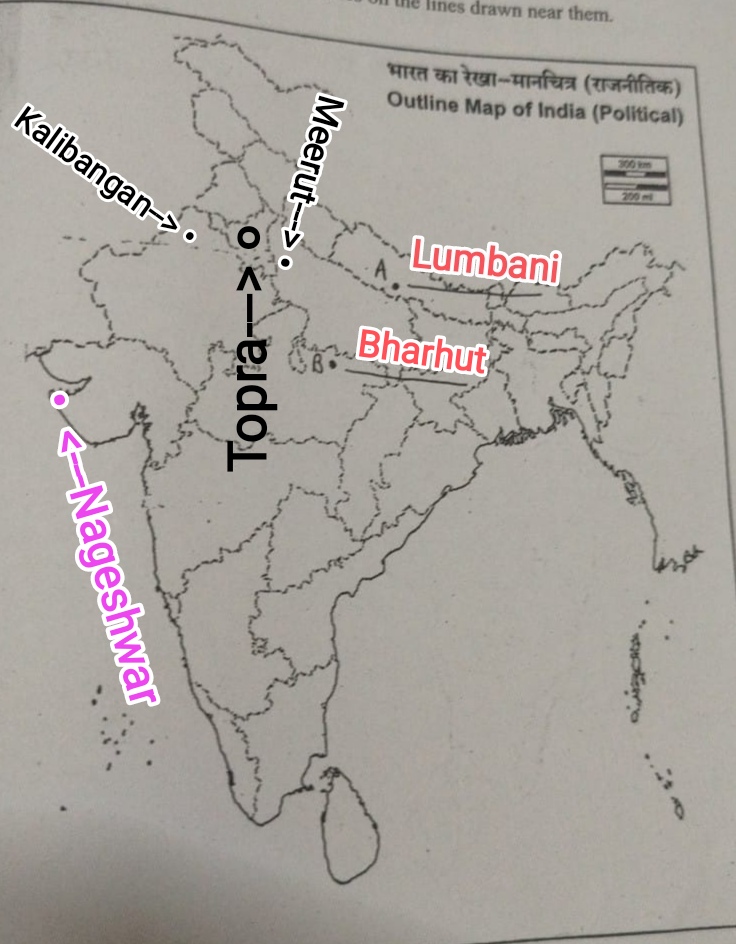
Answer : 34.2. A. lumbini B. Bharhut